Showing posts with label Crafts. Show all posts

Feb 19, 2019

Tibetan Temple #3

I rediscovered polymer clay after a 20 year hiatus. Back in the early 90s, I made beads and pins and jewelry items.

This time around, I had in mind the tiny lumberyard and all my little itty bitty constructions. For the Zendo, I formed a little platter, a bowl and a vase. In the midst of the experiments, I fell in love again with this versatile medium. There are a bunch of useless polymer items around my studio right now,  a giant red flower, some art deco pillars, on the way to making tiny creations for the Tibetan Temple:

Here is the tiny tile floor, made from a large sheet of polymer clay, conditioned and rolled out to accommodate my 7x7 inch plan. After baking, I cut out the corner tiles to make room for the 1x1 inch pillars.

The wood base for the temple is three sheets of basswood glued together and framed in around the tiles.

I was attracted to Buddhist teachings because of the three essentials: (a) ethical conduct, (b) mental discipline and (c) wisdom. Along the way, I learned about making malas (another post) and painting as a meditation.

While studying Thangka painting, mental discipline was necessary, as was patience with myself and for the slow emergence of anything resembling a Buddha.

This little tile floor will be painted blue, the base stained with red.

The miter box lessons from my son, Michael, come in handy with my tiny tools. I am pretty happy with my corners.

Tulku Jamyang and his wife, Chigme, invited me often to share their Tibetan dinners. It was all very mysterious to me, big bowls of chopped meat, tureens of thick soup, flat breads and sweet pastes and sticky rices. We ate heartily with fat spoons as well as our fingers and drank copious amounts of rich dark tea with coconut butter (no yaks for miles and miles).

When I work out my Tibetan Temple, I remember Tuklu Jamyang's teachings, and translate the sacred geometry into my constructions.

I have become more patient over the years through meditations of all kinds, other art forms, knitting, of course, but the memory of Mondays with Tulku Jamyang, his quiet teachings, his generous spirit, hover around me like a sprite.

As I teach myself to sculpt with polymer clay, I'll make a teacher, a student and a Buddha.


Feb 16, 2019

Tibetan Temple #2

From The Once and Future King by TH White:

“It is God who keeps the price secret, Uther. Not I.”

“God? God? What god? I have heard you speak of so many gods. If you mean Mithras...”

Says Merlin, “Mithras. Apollo. Arthur. Christ. Call him what you will. What does it matter what men call the light? It is the same light, and men must live by it or die. I only know that God is the source of all the light which has lit the world and that his purpose runs through the world and passes each one of us like a great river and we cannot check or turn it but can only drink from it while living and commit our bodies to it when we die.”

God is in the details. Of everything. And the Light.

The Shrines to the Divine project began in early 2018. I have cataloged here in the blog the process of the first little tea house and the final Japanese Shrine, the Zendo, both built in 2018.

Along the way of my life, I have had the privilege to study with, cook for and generally be around some lovely teachers, in the name of art, or food, or spiritual advice. I have sat at the feet of gurus, pranced around the fire as a deer with a Huichol shaman on Mt. Shasta, meditated on Paramahansa Yogananda's houseboat with Steven Seagal, studied with and fed Deepak Chopra and myriad other pop culture stars, looked at Tibetan Buddhism through the eyes of the Thangka painting monk, and cooked for large groups at a retreat center while spending my nights in a 400 square foot tipi. Alison Stillwell Cameron lived next door to my mother and sparked my interest in Chinese Sumi painting, my bookbinding instructors shared Japanese print making, Shibori fabric design, marbled papers and so much more.

I feel closest to the source of all the light when I am being creative.

The top image above floated across my Facebook timeline, posted by a friend. It is an art deco painting by Vittorio Zecchin who died in 1947. Look him up. He blows my mind. The Dominican nuns never showed us his paintings in Art Appreciation class.

When I saw this painting, not just the goddesses themselves but the intensity of the colors hit me like a whack in the chest. The moment pushed me into the long talked about Tibetan temple, because I had to get involved with those colors.

As a dedicated DIY nut job, I set out to make some fabric for the backdrop to the buddha's throne. Although I used red and gold on black in my first draft of the fabric pattern, the colors of the shrine with mimic those above in Zecchin's: orange and purple and violet ...with some red.


I took a photo of the finished 12 x 12 canvas and shrunk the design to the size of a postage stamp, repeated the pattern to fill an 8.5x11 sheet of paper-backed silk for printing, and voila!


A tiny silk curtain of my own design.


Aug 9, 2018

Jun 26, 2018

Cabled Afghan

There's a brief moment of overwhelm when starting a large project, but as soon as I remember my hobby motto, "No Hurry," I settle down. It's all about the knit and purl of it anyway, one stitch at a time. No deadlines, no money involved, just me, the knit and purl and a beautiful piece made at the end of a long off and on meditation.

My Goddaughter picked out the yarn. Her colors are bold and the yarn is washable worsted weight wool blend, very easy on the hands and skin while knitting.

These cables are based on ten stitches and ten rows and the afghan is built out of 60 stitch panels of each of the four colors. With any luck, this afghan will be about 54 inches by 60 inches, enough to cover two snuggly people.


Jun 25, 2018

Jun 22, 2018

Printable Fabric


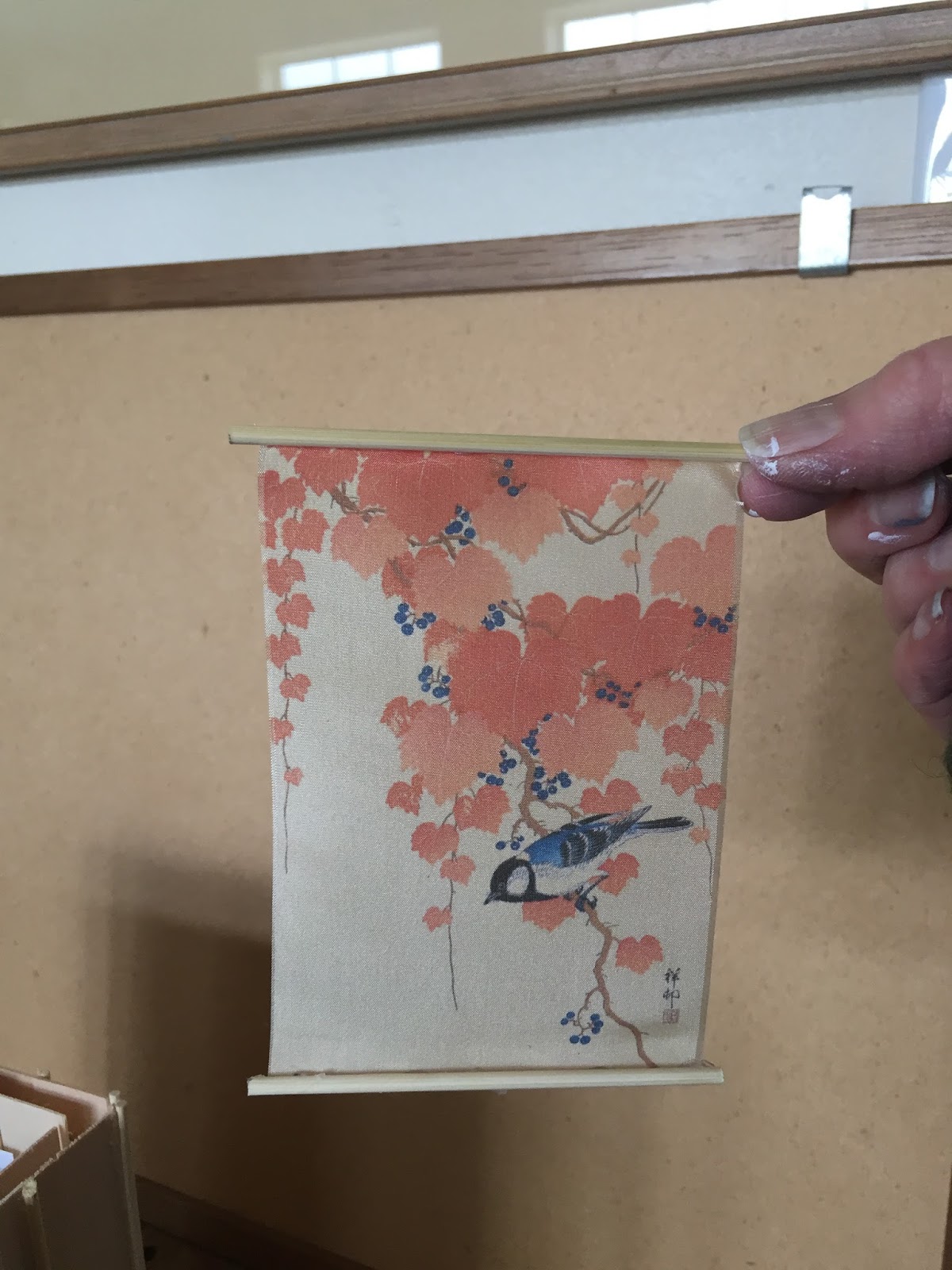
 Leftover from another project, I have packets of 8.5x11 sheets of printable fabric from Dharma Trading Co. in San Rafael, California: several grades of cotton, muslin and silk. These banners were printed on Haboti silk for tiny scrolls.


I am already imagining the tiny prayer flags fluttering on the Tibetan Buddhist Shrine.


May 29, 2018

The First Shrine #2

I am learning to think in layers of tiny lumber, like Basswood trimmed in skewers on the inside and outside of this shrine. The "studs" are Balsa wood, 1/16x1/4 inch.

When I first started the project, I slathered Elmer's glue on everything and waited for it to dry overnight before going on to the next step. Yawn.


I pondered why the videos and tutorials used Elmer's or wood glue and not hot glue which dries in a flash and reasoned that the hot glue was a bit uncontrollable for tiny gluing. But, this did not stop me.


I used my hot glue gun to put together this altar. What a difference. It went together in no time, is very sturdy, and allows me to keep going when I am on a tiny building roll and ready to finish the piece. It takes patience and finesse to keep from applying too much of a good thing but it is instant gratification.


May 22, 2018

Making Stuff - Planning a Shaman's Tipi

 These plans for a Plains Indian tipi are printed across twelve 8.5x11 sheets of paper to make the tipi below at 1/24 scale. The interior is about 10 inches in diameter and the cone top is at about 15 inches. Notice how the front slopes, which is part of the elegant design to keep the smoke (emanating from the fire pit in the middle) moving up and out of the smoke holes at the top.

The opportunities for making tiny things for a weenie tipi are endless, so endless, it kept me awake last night until I surrendered, turned on the light and scribbled all this down.

Here my list of items to make for the Shaman's Tipi:
cover
liner
threading pins
arrows
stack of wood
fire pit
rug - woven or felt
bed - fur (fake)
beaded bag
talking stick
pillows
blanket (woven or knitted)
back rests
walking stick
baskets
clay bowls
pots/hanging kettle
rattle
drum
pipe
smudge fan
sage wand
canoe

Of course, a canoe. Any self-respecting shaman would have his own canoe.

May 18, 2018

Getting the scale right....


 On the right are different sizes of paper tipis constructed while finding the proper scale dimensions.

1/24 means two feet per inch. I said this in an earlier post, but it's worth repeating that when we built Faerie Junction a year ago, the motto was, "Scale? Haha. Who cares? It's faeries! Just make it small."

With this project, I am inclined toward accuracy. Accuracy not only in the dimensions of the temples and shrines, but also with regard to the creation of the tiny tools and paraphernalia of devotion.

Watching glue dry causes a "get-it-done-now" girl much frustration. And, although my hobby motto is "No Hurry," I have chosen three very different cultural. i.e., devotional habitats to create in miniature to relieve me of boring drying time: the Shaman's Tipi, a Japanese Shrine and a Rose Window Screen.

Why these three, you might ask, when there is such a vast array of deities and devotions out there from which to choose? Here's why:

I have a small degree of Cherokee blood in my history. Even before I knew this, I constructed and lived in a tipi for two years while working at Rainbow Ranch in the early 90s. My tipi was 400 "square feet" of holy space: a place of refuge for the retreat cook making three meals a day. There is something special about living in that almost round structure. I slept well, meditated better and made pretty beaded jewelry at my little tabletop sitting on crates on the floor. (Read more about that in a post about Kitchens and chef-ing.)

After I left Rainbow Ranch, the owner was none to happy with my donation of the tipi to the center, since it wreaked a bit of havoc by blowing into a tree in a storm. However, my memories of it are clear. And for me, the tipi of a shaman would be a holy place.

If I have lived before, I have surely been Japanese. Long ago, when wondering why I put with with a rude design client who walked in front of me, I suddenly saw him as a 16th century Japanese Warrior, and I his wife, three paces behind. True or not, I honor Japanese design as well as the quiet calm of their devotions. Not to mention the most interesting roof lines.

The Rose Window? I love the rose window.

Three very different cultures and projects. But, imagine the tiny tools? More on that, next post.

Watch these grow into something! GB


May 12, 2018

Tiny Double Wall Construction #3


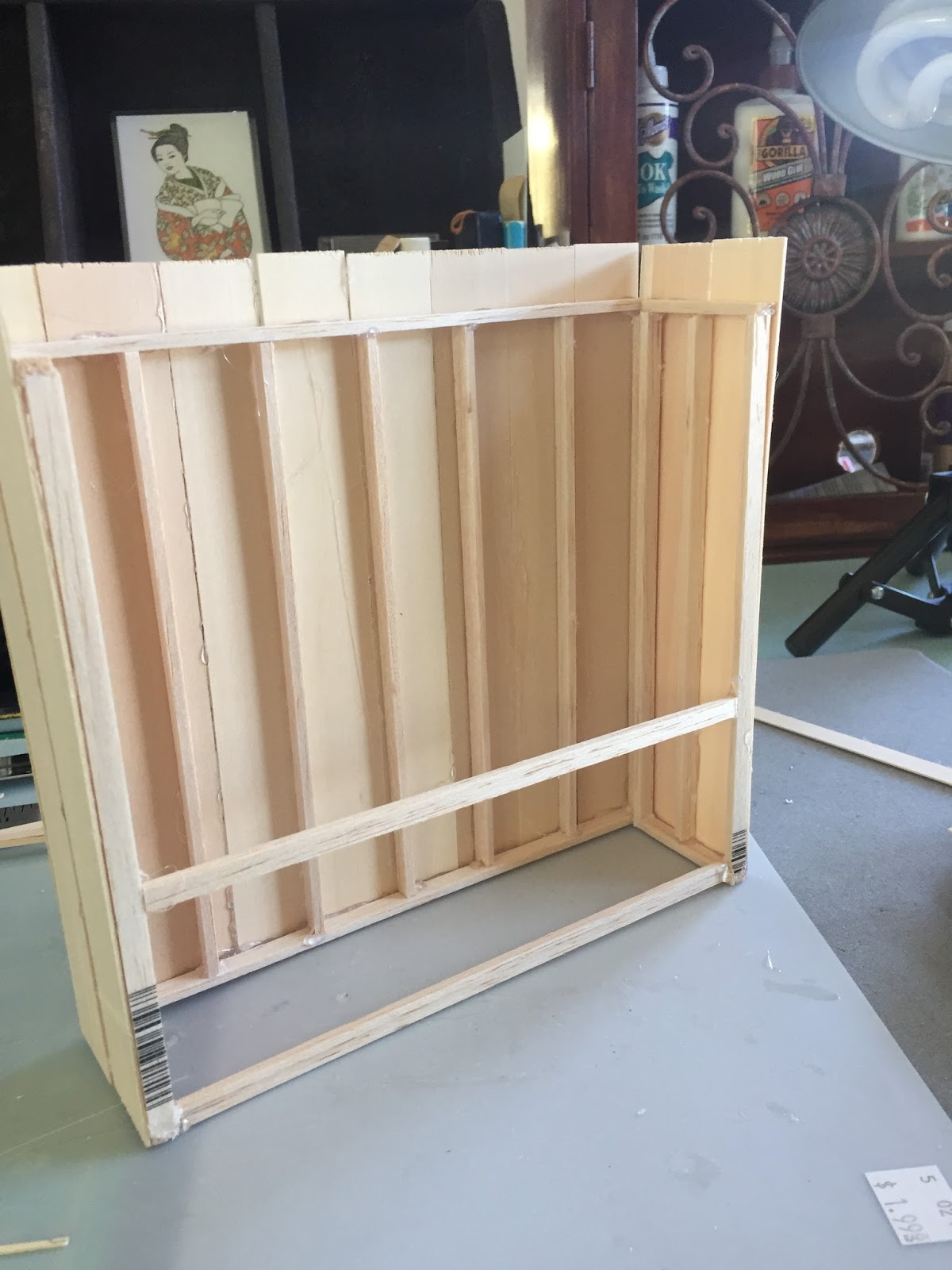
 When cutting the siding for this little model, I overlapped the edge about 1/4 inch to make the siding meet at the edges of the box. The windows are trimmed inside and out. I added a tidy and stabilizing trim to each corner. The trim boards are 1/4 inch taller than the walls in order to hold the roof, which will eventually be made when I figure out just what it is I've built here.

Is it a Japanese Temple? Is is a Presbyterian Church in Tokyo? Is is a tower in an English woods?


May 4, 2018

Tiny Double Wall Contruction

This weekend, I learned how to do tiny double wall construction by watching a You Tube video of a man building a complete replica of his home.

This little model has everything but wiring and insulation,

I used balsa wood trim pieces, although the ends are so soft the saw cuts look like a squirrel did the job, and, of course, craft sticks for the siding, only because I haven't found a decent replacement. For the future of this project, I can hardly see building Shrines to the Divine out of craft sticks.

 However, it did work for this siding, but I put a heavy weight (a covered brick) on the piece while drying to keep the siding from curling or warping.

The hardest part about tiny building is all the waiting time while different elements are gluing. From now on I will have two or three structures going at once.


May 1, 2018

Learning to be an architect and builder

 In the last post, I made the statement that everything I learned about tiny construction came from the YouTube tutorial I watched 25 times about building a Japanese Tea House. This is not true.

Here are three photos from 1988 when I studied scale models with an architect in Sausalito. I did a wonderful job on this tea house model. I wish I could remember all the details. I do remember that the shoji screen windows do not slide. So some techniques have improved.


 I can also see that the flooring and possibly the siding are made from craft sticks, which I am losing interest in rapidly. Warping is the issue. Craft sticks are fine if you do not plan to paint or stain the structure.


Mar 2, 2018

Afghan Stitch Sampler


A book called Pick Your Stitch, Build a Blanket by Doreen L.Marquart inspired me to make this lap robe above. The photo on the left is of the 36 squares stacked and ready to be sewn. The book has 80 different stitch patterns designed to make the same size squares. Very handy. Excellent instructions.

Mar 1, 2018

A Simple Scarf Project

This scarf is a great project for a beginner. It is done with a garter stitch all the way (knit, knit, knit forever) except for a little bit of checkerboard (knit four, purl four) until the right length. Just add on whatever colors you like. I used Merino Extra Superfine washable wool with size 7 needles. I  cast on thirty stitches and made it just long enough to lay comfortably across the chest, by request. It’s a soft, cozy beauty.

Feb 19, 2018

A Lampshade


In the back of a studio closet lives a large, trendy shopping bag of elegant, mostly never-worn clothes, passed on to me by a friend for quilting. The bag pulses with treasures: embroidered silks and shimmery jackets, voluminous wrap around silk pants that unfold to four yards of fluttering fabric.

The muse took me to the closet. La Muse loves closets. There are so many boxes to stir up in there. I was writing a post about making ketchup without sugar and she grabbed me by the collar and reminded me of a lampshade frame in that same closet, just calling out for a makeover. Why then? I don’t know.

My eyes lit on a blouse of blue/purple/red shantung silk embroidered around the neck and down the front with flowers and tiny sequins.


Before I knew it, the silk was ironed, the panel templates were made and my scissors were gliding through the fabric just as if I knew what I was doing. 12 panel strips cut and glued onto the wire frame and grosgrain ribbon hides the seams.


Next step is to let La Muse tell me where and how to apply the embroidery pieces. Stay tuned.